
As conflict that has thrown the country into chaos and uprooted more than a million people reached its sixth week, the warring factions in Sudan signed an agreement late on Saturday for a seven-day ceasefire, according to a joint statement from the US and Saudi Arabia.
Written by Chris Muhizi Minembwe Capital News 12:30pm Nairobi Kenya Time.
A breakdown in law has resulted from conflict between the Sudanese army and the paramilitary Rapid Support Forces (RSF). Food, cash, and essentials are running out quickly, and companies, banks, embassies, and aid storage facilities have all been heavily looted.
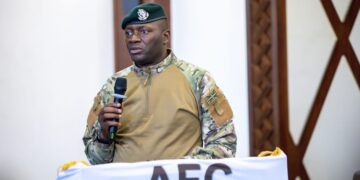
The RSF advisor also stated that he would be open to having talks with Abdel Fattah al-Burhan, the head of the sovereign council and commander-in-chief of the Sudanese army, both inside and outside of Sudan.
Hope has been voiced by an advisor to the commander of the Rapid Support Forces (RSF) that the Sudanese interim humanitarian truce will turn into a long-term ceasefire.
Al-Zain reiterated that the RSF would not leave the areas under their control and denied claims that the militia had looted and attacked Khartoum’s homes and hospitals.
However, locals continue to complain about theft and looting carried out by RSF members.
In a statement, the director of the Altigani Elmahi Psychiatric Teaching Hospital in Omdurman strongly denounced the theft of hospital assets, including cash, medications, laptops, and lab equipment.
Law and order have been destroyed as a result of combat between the Sudanese army and the paramilitary Rapid Support Forces (RSF). Stocks of food, money, and necessities are rapidly running out, and banks, embassies, companies, and assistance depots have all been targeted for widespread looting.
The RSF commander’s advisor refuted rumors that Hemetti had died or been hurt, saying that he is still with his troops and directly commands the combat.
Witnesses in southern Omdurman and northern Bahri, the two cities that make up Sudan’s “triple capital” and are located on opposite sides of the Nile from Khartoum, reported airstrikes on Saturday.
The eyewitnesses in Omdurman reported that some of the strikes occurred close to the national broadcaster.
The latest diplomatic station to be targeted was Qatar’s embassy on Saturday, which drew outrage from Doha.
The government said that “none of the diplomats or embassy staff were subjected to any harm” because “the embassy staff had previously been evacuated.”
Calls for “an immediate halt to the fighting” were reiterated.
However, a statement by the pro-Burhan authorities placed the blame fully on the paramilitaries. Qatar did not directly name the RSF as the culpable party.
In the recent weeks, there have also been attacks on the embassies of Jordan, Saudi Arabia, and Turkey.
The RSF is integrated in residential areas and is targeted by regular armed forces airstrikes practically constantly.
Eyewitnesses in Khartoum reported that although there were sporadic gunshots heard, the atmosphere was otherwise peaceful.
Since the conflict’s start on April 15th, about 1.1 million people have been internally and internationally displaced.
The World Health Organization reports that there have been 705 fatalities and at least 5,287 injuries.
The rioting and bloodshed persisted in different Khartoum neighborhoods on Sunday, barely hours before the seven-day ceasefire began that evening.