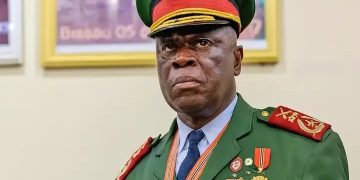

Five years after the massacre, Philippe Hategekimana, 66, escaped to France and applied for asylum using a false identity. In the city of Rennes, he started working as a university security guard after obtaining French citizenship in 2005.
Written by Chris Muhizi Minembwe Capital News 10:30am Kigali Rwanda time
A former member of the Rwandan military police who fled to France during the 1994 genocide and established a new life under a fictitious name is currently on trial in Paris for alleged crimes against humanity.
Hategekimana, a senior police official who was involved in the killing of several Tutsis, is accused of setting up barriers to impede the Tutsis who would otherwise be slain in and around Nyanza, the seat of the southern province. His denial of the accusations.
He has been accused of taking part in the atrocities that occurred during the Rwandan genocide, which murdered 800,000 people between April and July 1994, the majority of whom were members of the Tutsi ethnic group.
After news broke that the Collective of Civil Parties for Rwanda, one of the plaintiffs in this week’s trial, had lodged a complaint against him, he left France for Cameroon in the latter part of 2017. 2018 saw his arrest in Yaoundé, the nation’s capital, and his extradition to France.
He may have participated in the deaths of a nun and the mayor of the village of Ntyazo, who spoke out against the executions.
Additionally, he is suspected of taking part in an assault on one refugee camp and the murder of 300 Tutsi refugees on the Nyamugari hill.
Plaintiffs claim that he participated in the genocide by “using the powers and military force conferred upon him by his rank.”
Additionally, he is charged with participating in the murder of 300 Tutsi refugees on the Nyamugari hill and the slaughter of about 1,000 people during an assault on the Nyabubare mountain.
Since a historians’ study commissioned by Emmanuel Macron and published in 2021 acknowledged France’s “overwhelming” culpability in failing to stop the atrocities, relations between France and Rwanda have improved significantly.
For several decades, Kigali accused France—one of the main locations for those fleeing the atrocities—of providing protection to Rwandan genocide suspects.
The majority of extradition petitions to France have been denied, leading Rwanda’s president, Paul Kagame, to claim that Paris is denying Rwanda authority.
A former espionage head was given a 25-year prison term in 2014 during the first Rwanda genocide trial in France. Since then, similar charges have been brought against two former mayors, a former hotel chauffeur, and a former senior official. Later this year, a doctor from Rwanda named Sosthene Munyemana who has lived in France since 1994 will stand trial there.