
When a Journalist Wears a Uniform and Carries a Gun: Burkina Faso’s Powerful Lesson to the World on the Boundaries Between Journalism, the State and War
Minembwe Capital News
As countries around the world grapple with war, terrorism, and security crises, the relationship between governments and the media is becoming an increasingly important subject of international debate: Can a journalist love their country without compromising their professional independence? And when a country is at war, does patriotism require a journalist to take up arms and join the military?
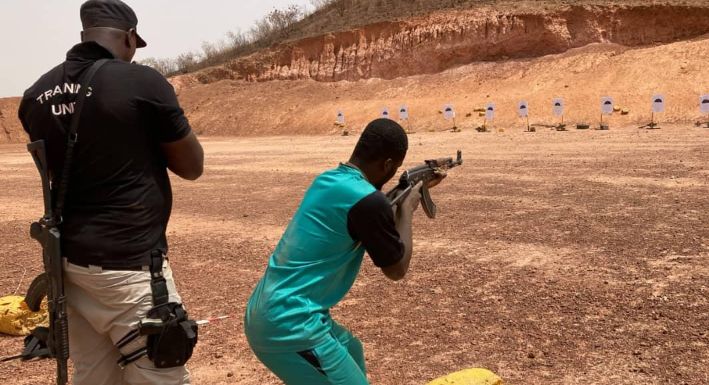
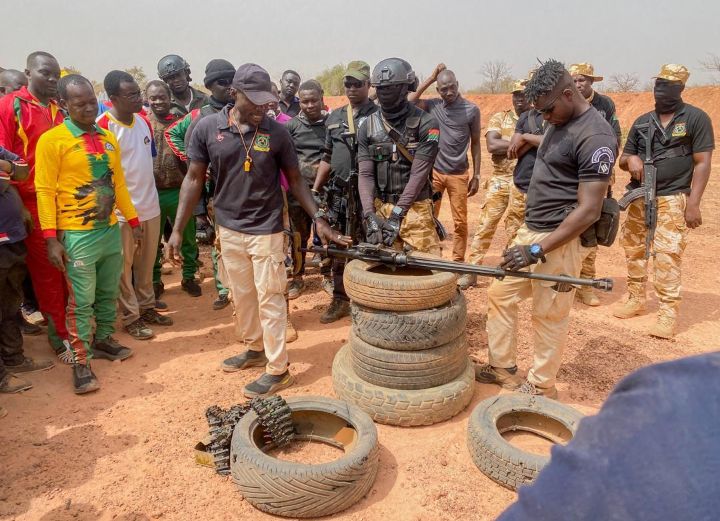
Burkina Faso has presented the world with an unusual example that is likely to fuel further debate. More than 40 journalists working for both state-owned and private media outlets took part in a military training programme designed to instill what authorities describe as “patriotic” values.
The training took place at the Pabré Police Academy, near the capital Ouagadougou, at a time when Burkina Faso is engaged in a serious conflict with jihadist armed groups operating across the Sahel.
The programme cannot simply be viewed as ordinary training. It raises a fundamental question about the role of journalists during wartime: Should a journalist become an instrument for defending the state, or should they remain the eyes and ears of the public, including when scrutinizing the government itself?
A Programme Launched Under Military Rule
Burkina Faso has been led by Captain Ibrahim Traoré since the military takeover in 2022. Since then, the authorities have placed significant emphasis on programmes aimed at promoting patriotism and encouraging citizens to contribute to the defence of the country.
These efforts have intensified because of insecurity caused by attacks carried out by armed groups linked to al-Qaeda and the Islamic State.
From the government’s perspective, the argument is straightforward: the country is at war, and therefore every Burkinabè citizen has a role to play in defending it.
This approach is also reflected in programmes designed to instill civic values among young people. The government has explained that some educational initiatives are intended to teach national history, patriotism, peaceful coexistence, social cohesion, relations between different communities, and geopolitical awareness.
But when such a programme reaches journalists, the question becomes considerably more complicated.
Journalists in Military Uniforms, Carrying Weapons
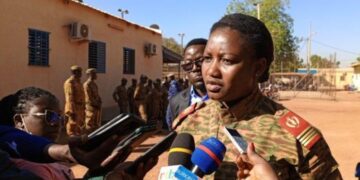
During the latest training, more than 40 journalists from both public and private media outlets wore military uniforms and received training related to the operations and functioning of security institutions.
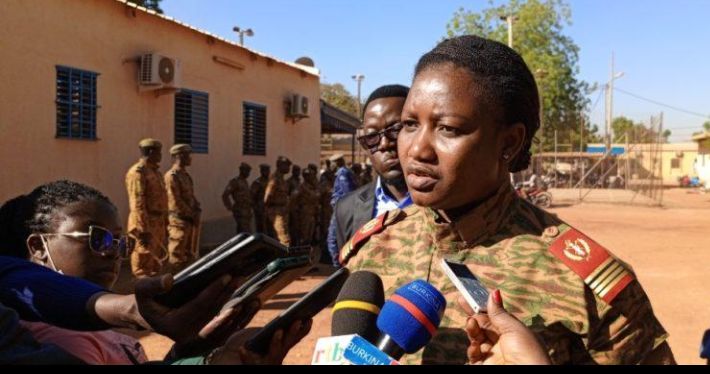
The head of the Pabré Police Academy explained that the objective was to help journalists better understand the activities, operations, and values governing the security forces and the military.
The Minister of Communication and Government Spokesperson, Pingdwendé Gilbert Ouédraogo, was also seen speaking with journalists dressed in military uniforms.
He asked them whether they would be patriotic and professional journalists, to which they responded: “Yes.”
This was followed by a striking statement that has drawn significant attention:
“A professional journalist who is not patriotic is committing terrorism.”
The statement illustrates how the authorities in Burkina Faso view the role of the media during wartime: journalism should not merely report events; it should also contribute to the country’s struggle against armed groups.
But this raises a critical question:
Who decides whether a journalist’s reporting is an act of service to the nation or an act of “terrorism”?
Should a Journalist Be Patriotic? Yes. But Patriotism Does Not Mean Serving the Government
Patriotism itself is not the problem.
A journalist can be a citizen who deeply loves their country, wants its people to live in peace, wants the nation protected from those who threaten it, and wants its sovereignty respected.
But journalists have another distinctive responsibility that separates them from soldiers and gives them a unique role in society.
A soldier fights to defend the country.
A journalist works to ensure that citizens know the truth about what is happening in their country.
These two responsibilities may ultimately serve the same broad objective of protecting citizens, but they operate in fundamentally different ways.
A journalist may report information that helps a country confront terrorism, but they must also retain the ability to ask difficult questions of the authorities.
They must also be able to report on military failures, abuses against civilians, corruption, poor governance, or misconduct by public officials when such matters are in the public interest.
When journalists become afraid to ask difficult questions because they may be labelled “unpatriotic,” journalism ceases to function as a public platform and begins to resemble a government communication channel.
A Journalist Is Not a Soldier
The international press-freedom organisation Reporters Without Borders (RSF) has for some time criticised the way the authorities in Burkina Faso have invoked the concept of “patriotism” in relation to journalism.
RSF says that since Ibrahim Traoré’s military government came to power, journalists in Burkina Faso have faced significant pressure, including arrests, questioning, media suspensions, and forced military recruitment.
RSF has also reported cases in which journalists critical of the authorities were allegedly forced into military service, which the organisation regards as an attack on press freedom.
In 2026, RSF ranked Burkina Faso 110th out of 180 countries in its World Press Freedom Index, noting that insecurity and political instability have had serious consequences for the media environment.
This is important because the issue is not simply the military uniform itself.
The deeper concern is whether journalists could begin to lose their independence when they are expected to become participants on one side of a conflict.
But Burkina Faso Has Its Own Rationale
It would not be professional to judge Burkina Faso’s approach without considering why the country has chosen this path.
For years, the country has faced attacks by armed groups that have killed large numbers of civilians, disrupted the economy, and made some parts of the country extremely difficult for journalists to access.
In such circumstances, a government may view the media as part of the broader struggle against the propaganda of armed groups.
And there is some truth behind that concern: misinformation can be extremely dangerous during wartime.
A journalist who fails to verify information can frighten civilians, disclose sensitive information that could put soldiers or civilians at risk, or inadvertently become a vehicle for armed groups seeking to spread propaganda.
That is why journalists should receive serious training in security, conflict reporting, information verification, and the identification of propaganda.
But security training does not necessarily mean that a journalist must become a soldier.
Is This Programme Good or Bad?
The answer should not simply be “yes” or “no.”
Some elements of the programme may be constructive, while the way it is implemented could create serious concerns.
If journalists are being taught:
- the history of their country;
- how security institutions operate;
- how to work safely in conflict zones;
- how to protect their lives;
- how to identify propaganda and disinformation;
- how to work with communities during disasters and armed conflicts;
- security laws and human rights standards;
then there is little inherently problematic about such training.
Indeed, such programmes can be extremely valuable.
But if “patriotism” means that journalists must report only what the government wants them to report, then a serious problem emerges.
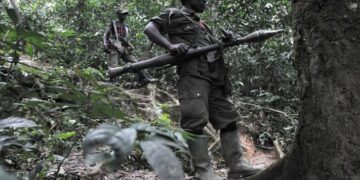
And if journalists are given weapons and military uniforms so that they become part of the armed forces, the distinction between journalist and combatant begins to disappear.
That could place journalists at even greater risk because combatants may no longer perceive them as independent media workers.
The Lesson Burkina Faso Could Offer the World
Burkina Faso may be offering a powerful lesson to every country facing war or terrorism.
The first lesson is that a country needs citizens who love and are committed to their nation.
The second is that journalists need to understand the security challenges their countries face.
But the third—and perhaps most important—is that patriotism should never replace truth.
A strong country is not one in which everyone says the same thing because they fear the government.
A strong country is one in which citizens can speak the truth and authorities can accept criticism when that criticism is intended to expose problems and improve governance.
Even during wartime, countries need professional journalists more than ever because reliable information can be as important to society as military equipment.
Who Is a Journalist During Wartime?
A journalist is not an enemy of the state.
A journalist is not a government spokesperson.
A journalist is not a military spokesperson.
A journalist is not a spokesperson for an armed group.
A journalist should be a witness to history, accountable to the public and committed to the pursuit of truth.
During wartime, those responsibilities become even more demanding:
Observe. Ask questions. Seek evidence. Verify information. Distinguish truth from falsehood. Give a voice to those who have none. And remain accountable for what is published.
This does not mean that journalists should publish everything they discover.
A professional journalist must understand that certain information can put human lives at risk. They may choose not to immediately disclose sensitive details about military operations when doing so could endanger soldiers or civilians.
But such decisions should be guided by professional ethics and the public interest—not simply by an instruction to publish only what the government wants the public to know.
The Role of the Media in Nation-Building
The media plays a crucial role in building a nation.
It can:
Educate citizens — by providing information that helps people understand their country and the wider world.
Fight misinformation — by verifying information before publication.
Combat corruption — by investigating the misuse of public resources.
Protect human rights — by giving a voice to people who are abused or lack the power to defend themselves.
Connect citizens and government — by bringing citizens’ concerns to public officials.
Hold power accountable — by asking difficult questions and exposing failures by those in authority.
Assist during disasters and conflicts — by providing information that helps people make decisions that protect their lives.
It is this watchdog function that has led journalism to be described as the “eyes of the public.”
When the “Eyes of the Public” Become the Eyes of the Government
The greatest danger emerges when journalism begins to believe that its primary responsibility is to constantly defend the government rather than defend the truth.
When that happens, citizens begin to lose access to reliable information.
Government failures are concealed.
People may begin to believe that everything is going well, even when serious problems are being hidden from view.
During wartime, this can become even more dangerous because reliable information is needed more than ever.
RSF has said that the “patriotic” treatment of news promoted under Captain Ibrahim Traoré’s government has placed pressure on investigative and critical journalism.
The organisation has also reported that pressure on journalists in Burkina Faso has included arrests, questioning, media suspensions, and forced military recruitment.
What Should the World Be Asking?
The question Burkina Faso has brought before the world is not whether journalists should love their countries.
They should.
The real question is:
Can a journalist love their country while continuing to tell the truth—even when that truth is critical of the government?
If the answer is yes, then the country can have a strong and independent press.
If the answer is no, journalism risks becoming an extension of the government’s communication machinery.
And when that happens, citizens no longer have journalists telling them what is actually happening; they have people repeating the version of events that the authorities want them to see.
Conclusion: A Country Needs Patriots, But Journalists Must Remain Professionals
Burkina Faso is living through extraordinary circumstances. It is fighting armed groups, confronting severe security challenges, and seeking to involve every sector of society in the defence of the nation.
The objective of encouraging citizens to contribute to national defence is understandable.
But there is a line that should not be crossed:
A journalist can be a patriotic citizen without becoming a soldier simply to prove their patriotism.
A country needs soldiers with weapons.
It needs police officers responsible for maintaining security.
It needs scientists, doctors, teachers, engineers, and professionals working across different sectors.
But it also needs journalists equipped with pens, cameras, microphones, and the independence to tell the truth.
When a weapon is in the hands of a soldier, its purpose is to defend the country.
When a camera is in the hands of a journalist, its purpose is to show the world what is happening.
A country is strongest when it has both: security protected by those entrusted with defending it, and truth protected by an independent and professional media.
Minembwe Capital News’ Perspective
The approach taken by Burkina Faso deserves serious examination by every country experiencing war, particularly across Africa.
Training journalists in security awareness, military structures, conflict reporting, propaganda detection, and working safely in war zones can be highly valuable.
But such training should never become a mechanism for telling journalists what they are allowed to report.
Loving one’s country does not mean hiding its failures. Loving one’s country also means having the courage to expose those failures so they can be corrected.
And an independent media is not an enemy of the state.
When it functions properly, it can become one of the strongest institutions a country has for combating corruption, abuse, disinformation, poor governance, and injustice.
Burkina Faso therefore leaves the world with a profound question:
In times of war, where should the line be drawn between patriotism and the independence of the press?
The answer may determine whether wartime journalism becomes the voice of the nation, the voice of the government, or the voice of truth.
Minembwe Capital News