
The U.S.–DRC Strategic Partnership Remains Under Scrutiny: Strong Diplomatic Commitments, but Tangible Investment Has Yet to Materialize
MINEMBWE CAPITAL NEWS (MCN)
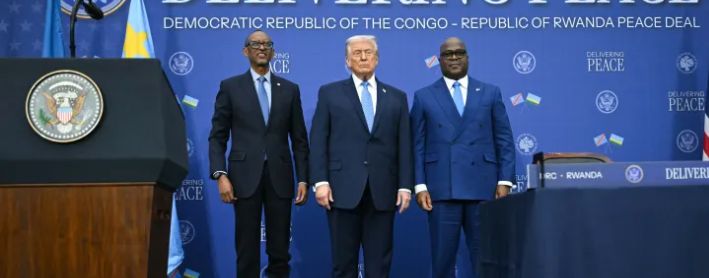
More than seven months have passed since Rwanda, the Democratic Republic of the Congo (DRC), and the United States signed the Strategic Partnership Agreement (SPA) on December 4, 2025. The agreement was presented as a landmark initiative aimed at strengthening economic cooperation, advancing infrastructure development, securing critical mineral supply chains, and attracting substantial American private investment.
Since then, both the governments of Kinshasa and Washington have consistently emphasized that the agreement would usher the DRC into a new era of economic development through modernized infrastructure, expanded cross-border trade, job creation, and sustained economic growth.
In recent weeks, the DRC Council of Ministers also approved a project related to the implementation of the Lobito Corridor, a strategic transport corridor designed to connect the DRC’s mineral-rich regions with the Port of Lobito in Angola. The project continues to be presented as one of the cornerstone initiatives of the U.S.–DRC strategic partnership.
Despite continued diplomatic messaging expressing confidence in the partnership, an important question remains among economists and observers of international affairs: Where is the tangible American investment that has already reached the DRC?
From an economic perspective, the existence of an agreement alone is not sufficient evidence of meaningful change. What ultimately matters is whether private companies decide to invest after conducting comprehensive assessments of security conditions, the legal framework, taxation, environmental standards, governance, and projected financial returns.
However, since the agreement was signed, there have been no publicly announced indications that major American corporations have launched significant project evaluations or initiated large-scale investment activities in the DRC. There have been no widely reported due diligence processes, no publicly available implementation timelines, no major new investment agreements at scale, and no significant industrial or infrastructure projects officially launched as a direct result of the partnership.
Economic analysts argue that this reality deserves careful attention. American companies are widely recognized for conducting extensive due diligence before entering new markets. They typically evaluate legal certainty, security, taxation, governance, regulatory stability, and long-term economic prospects before committing investments worth billions of dollars.
This rigorous assessment process is precisely what has earned many U.S. companies a reputation for making cautious, evidence-based investment decisions rather than acting solely on political announcements or diplomatic commitments.
Had the U.S.–DRC partnership already begun producing concrete economic results, observers would reasonably expect to see indicators such as technical teams conducting field assessments, feasibility studies underway, high-level negotiations on investment agreements, and clearly announced project implementation schedules. To date, however, such indicators remain limited or have yet to emerge at the scale initially anticipated.
Nevertheless, the Lobito Corridor continues to be regarded as one of the region’s most strategically significant infrastructure projects. Once completed, it is expected to facilitate the transportation of critical minerals from the DRC to the Port of Lobito in Angola, reducing logistical bottlenecks while opening new export routes and commercial opportunities.
Even so, economists caution that infrastructure alone does not automatically generate private-sector investment. Sustainable investment depends on investor confidence, predictable legal and regulatory frameworks, long-term security, sound governance, and the prospect of attractive financial returns.
For this reason, some analysts point to a growing gap between the volume of diplomatic announcements and the level of tangible economic activity on the ground. The partnership continues to receive considerable attention in international forums, media coverage, and public communications. Yet when measured by actual investment flows, new industrial projects, or capital already deployed, concrete evidence remains limited.
This does not necessarily suggest that the Washington–Kinshasa agreement has failed or that it will not eventually deliver meaningful results. Rather, it highlights the distinction between the pace of diplomacy and the longer timeline typically required for investment decisions to mature.
In practice, international agreements establish frameworks for cooperation, but they do not automatically translate into immediate investment. Investment decisions ultimately depend on investor confidence, operational security, legal certainty, good governance, and expected long-term profitability. No political declaration can substitute for these fundamental investment requirements.
It is therefore understandable that analysts, economists, and the broader public continue to question the current stage of implementation of the agreement. The credibility of any international partnership is measured more by tangible outcomes than by official statements or diplomatic declarations.
In conclusion, experts emphasize that economic diplomacy cannot rely indefinitely on agreements alone. In the field of international investment, concrete projects, committed capital, and completed infrastructure provide far stronger evidence of success than political rhetoric. As time continues to pass, attention will remain focused on whether the U.S.–DRC strategic partnership will ultimately translate into substantial investment on the ground or continue to be defined more by diplomatic announcements than by measurable economic results.