
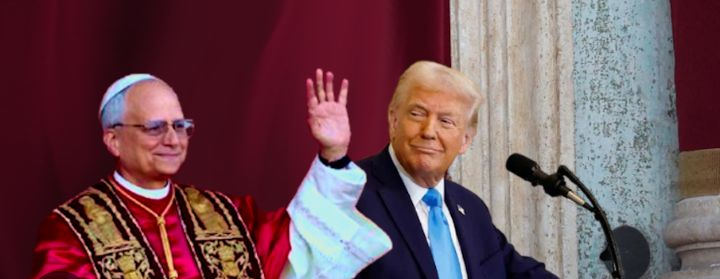
President Trump and Pope Leo XIV Renew Sharp War of Words, Sparking Global Debate
As the world continues to closely follow the relationship between international politics and the leadership of the Catholic Church, United States President Donald Trump has once again stirred controversy after strongly criticizing Pope Leo XIV, accusing him of adopting positions that could favor Iran and endanger Catholics around the world.
Trump’s remarks have received widespread attention in international media, especially as they come at a time when U.S. Secretary of State Marco Rubio is preparing for a major visit to the Vatican aimed at easing tensions between Washington and the Catholic Church.
During an interview with conservative political commentator Hugh Hewitt, Donald Trump made strong statements directed at Pope Leo XIV. Trump claimed that the Pope appeared to be taking a softer stance toward Iran regarding the issue of nuclear weapons.
Trump stated:
“The Pope seems to believe that Iran should be allowed to possess nuclear weapons, and that could put many Christians and many other people around the world in danger.”
These comments immediately triggered intense debate, particularly because there is no evidence that Pope Leo XIV has ever publicly supported Iran acquiring nuclear weapons. Instead, the Pope has consistently called for peaceful dialogue and an end to wars, while criticizing inflammatory rhetoric and military attacks that could harm civilians.
Responding to Trump’s remarks, Pope Leo XIV emphasized that the mission of the Church is not political, but rather centered on spreading the message of peace and the Gospel.
He said:
“The mission of the Church is to preach the Gospel and promote peace. If someone criticizes my words because of God’s message, what matters most is that people understand the value of that message.”
These remarks highlighted what many observers see as a major contrast between Trump’s rhetoric, which is rooted in political power and national security, and the Pope’s message, which focuses on peace and biblical teachings.
The tension between Donald Trump and Pope Leo XIV did not begin recently. In previous months, Trump had already criticized the Pope over comments regarding migrants and immigration policies, after the Pope condemned the continued deportation of migrants and criticized war-driven policies.
Pope Leo XIV had previously declared:
“God does not listen to the prayers of those who promote war.”
Many interpreted those remarks as an indirect criticism of Trump’s policies, particularly his hardline security strategies and his support for aggressive military actions.
The controversy intensified further after Donald Trump once posted on social media an image portraying himself in a manner resembling Jesus Christ, a move that provoked outrage among many Christians and Church leaders. Although the post was later deleted following heavy criticism, Trump refused to apologize, insisting that it had merely been intended as a joke.
These tensions come as Marco Rubio prepares for a diplomatic visit to the Vatican to discuss issues including global peace, religious freedom, and international security.
Rubio, who is himself a devoted Catholic, stated that there are “many important issues to discuss with the Vatican.” However, political analysts believe Trump’s recent comments could complicate those discussions.
The controversy has also drawn reactions from Italian leaders. Italian Prime Minister , who is widely regarded as an ally of Trump, reportedly expressed discomfort with Trump’s behavior toward the Pope.
Meanwhile, Italy’s Foreign Minister said that attacks against the Pope were “unhelpful and harmful to global peace.”
Antonio Tajani also reaffirmed his support for Pope Leo XIV’s message promoting dialogue, human dignity, and peace.
Could This Affect Trump Politically?
Political analysts in the United States believe that these disputes could have consequences for Donald Trump ahead of upcoming congressional elections, particularly because Catholics represent a significant portion of the American electorate.
There are growing concerns that continued clashes with the Pope could alienate some Catholic voters, especially those who prioritize peace, human rights, and humanitarian values.
Nevertheless, Donald Trump continues to show little concern about criticism of his rhetoric, insisting that he will keep speaking openly about issues related to national security, Iran, immigration, and global conflicts.