

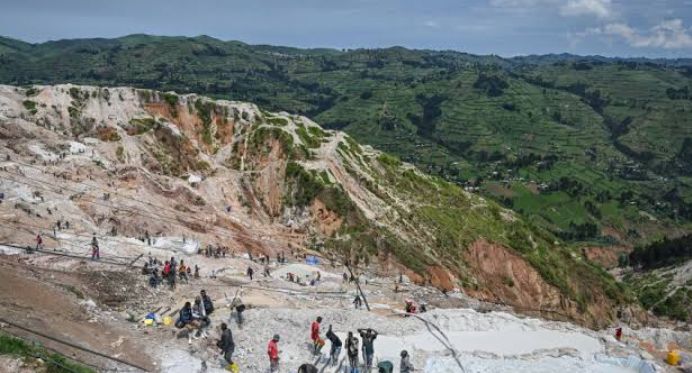
Rubaya at a Critical Crossroads: Mines Attract U.S. Companies Amid Political and Security Tensions in the DRC
In the eastern Democratic Republic of the Congo (DRC), the security situation continues to deteriorate, increasingly intertwined with major economic interests linked to mineral resources. This is particularly evident in the Rubaya mines, located in Masisi territory, which have drawn strong interest from numerous U.S. companies due to their significant coltan reserves—estimated to account for nearly 15% of global production.
The Rubaya mines are considered the heart of coltan extraction in the Great Lakes region. Coltan is a critical mineral used in the manufacturing of modern technological devices, including smartphones, computers, and other globally essential electronics. As a result, Rubaya has become a focal point for powerful nations and multinational corporations seeking access to these valuable resources.
As part of efforts to strengthen economic cooperation, the DRC government submitted a list of mining sites to the United States that could be opened to investment by American companies. This initiative follows agreements signed between the two countries in late 2025, aimed at promoting investment and enhancing cooperation in economic and industrial sectors.
However, a major challenge lies in the control of these mining sites. Currently, Rubaya has been under the control of the AFC/M23 coalition since May 2024. This has sparked intense debate over the legitimacy of offering mining concessions in areas not under government authority.
The AFC/M23 coalition has strongly criticized the DRC government’s decision to include Rubaya on the list of potential investment sites, arguing that it reflects the state’s continued failure to reestablish sovereignty over its territory. The group maintains that no credible agreements can be made regarding resources that the government does not effectively control.
From the United States’ perspective, interest in Rubaya is evident. According to Reuters on April 20, 2026, a senior U.S. State Department official confirmed the country’s strong interest in the site, stating: “Rubaya is important to us. Many companies are interested, and discussions are ongoing.”
The official also noted that the U.S. views Rubaya as a key source of instability in eastern DRC, where various actors compete for control due to its high value. Washington believes that developing the site through formal, regulated international agreements could help reduce conflict while contributing to regional economic growth.
Historically, the Rubaya area has been a persistent hotspot of conflict. Forces from the DRC, Burundi, and armed groups such as Wazalendo and FDLR have repeatedly clashed with AFC/M23 in ongoing confrontations. This instability has led to largely unregulated mining activities, which at times have financed armed groups.
Analysts warn that without strong oversight and effective governance of natural resources, coltan mining in Rubaya may continue to fuel conflict rather than serve as a foundation for development. Nevertheless, there remains cautious optimism that international cooperation could introduce more transparent and sustainable approaches to resource management.
As negotiations continue between the DRC government, the United States, and private companies, the future of Rubaya remains uncertain.